 Ignition
Timing Control
Ignition
Timing Control
(or “How I Learned
Japanese”)
The traditional distributor advance curve has long been computer controlled in modern EFI vehicles. Typically, there is a pair of signals generated by the distributor as it is spun by one of the camshafts and that signal is manipulated by the ECU as predicated by engine conditions and RPM. On the typical vehicle, if a tuner desires more ignition advance – which can afford more low-end power – all that must be done is encompassed in a small rotation of the distributor.
However, manipulating the ignition timing – advancing or retarding it at will – is an issue that has been discussed frequently in the MX-3 community. The reason it is such an issue of contention is largely because of the presence of a third control signal generated by a magnetic pickup on the crank pulley. A signal of this type is not unusual and many vehicles use it in lieu of its counterpart in the distributor. However, in the MX-3 the crank angle sensor ultimately will override any advance dialed into the distributor manually, despite the presence of a synchronously timed position signal there. This would appear to be an attempt on the part of the Mazda engineers that designed the system to maintain the precise relationship between the crank and camshafts. Once the relationship between the two is established in the diagnostic mode (pin TEN grounded in the diagnostic header), the ECU will base its timing adjustments on the signal from the crank position sensor and will compensate for the small fluctuations that occur due to timing belt flex, vibration and drive delays.
This means that the only way to move the timing is to physically remove the crank pulley and reposition the position trigger to advance or retard the timing. This method is not only cumbersome, but of little practical use, especially in my application since I needed to completely reshape the ignition timing and curve, not just advance it.
Because I wanted significant advance in the low RPM ranges to allow for the high octane gas I use at the same time as several degrees of retard in the 4200 RPM+ to compensate for pre-ignition due to more than 9 PSI of boost and significantly higher intake temperatures generated by the supercharger, I needed a control interface that could alter the timing signals from the crank position sensor and the distributor from inside the car and on the fly.
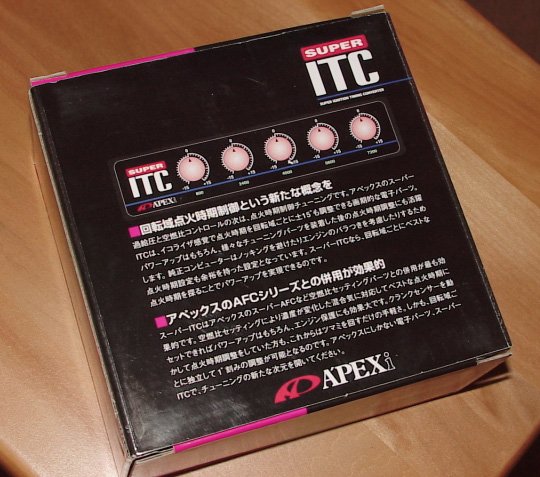
 Enter the Apexi S-ITC or
Super Ignition Timing Controller.
Enter the Apexi S-ITC or
Super Ignition Timing Controller.
This device offers the ability to intercept and modify the timing signals much the same way that the AFM Link does the air-flow signal from the VAF.
The S-ITC offers 5
interpolated RPM-dependant adjustment ranges with up to 15º of advance or
retard. This seems perfect except for one minor catch – the S-ITC is not
designed for the MX-3. Unfort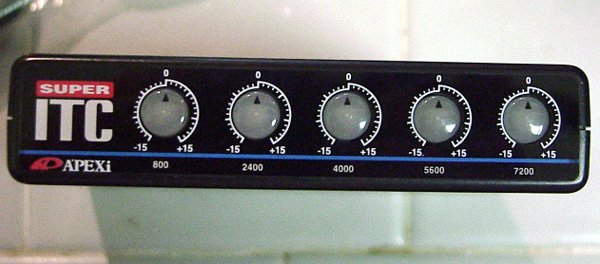 unately, I wasn’t really aware of this fact
until I had ordered and received one so I became dedicated to the task of
retrofitting it to my application. This goal was further hindered by the fact
that the manual that comes with the unit is completely in Japanese and my
Kanji and Katakana skills are not so strong (read: non-existent).
unately, I wasn’t really aware of this fact
until I had ordered and received one so I became dedicated to the task of
retrofitting it to my application. This goal was further hindered by the fact
that the manual that comes with the unit is completely in Japanese and my
Kanji and Katakana skills are not so strong (read: non-existent).
Apexi USA was of little help. The S-ITC is the only device for which they haven’t a translated manual and the tech support people don’t have a clue on how the device actually works.
So, after several days of reverse engineering and testing I was able to gleam considerable insight into the function of the S-ITC as well as learn a good bit of Japanese.
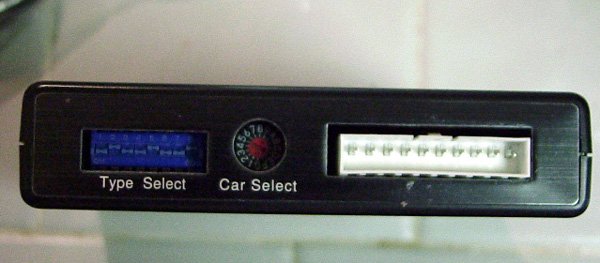 On the back of the S-ITC
there are two selectors: an 8 position DIP-switch labeled “car select” and
a 16 position rotary switch labeled “type select”.
On the back of the S-ITC
there are two selectors: an 8 position DIP-switch labeled “car select” and
a 16 position rotary switch labeled “type select”.
The DIP array is entirely dedicated (with the exception of the #1 switch which is a documented range of adjustment switch) to selecting the type of individual outputs the ECU expects to see from the timing sensors and the S-ITC should emulate; either “trigger” type low voltage signals or “logic” type 5 volt square functions.
The rotary switch selects which inputs are active and whether the signals are positive or negative onset (i.e. normally high or low).
The wires are paired as input/output channels:
blue and light blue are channel one which are controlled by DIPs 8 and 5 respectively
white and pink are channel two which are controlled by DIPs 7 and 4 respectively
yellow and green are channel three which are controlled by DIPs 6 and 3 respectively
DIP 2 is a threshold switch that adjusts where in the voltage rise the logical flip/flop will occur.
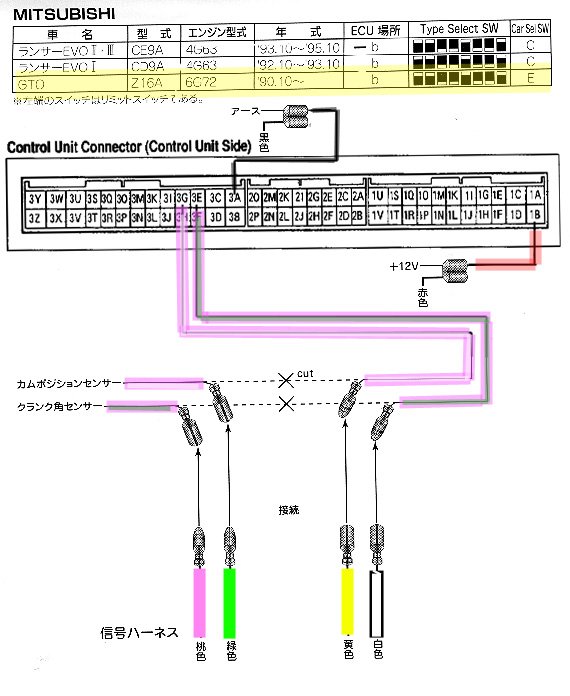 Since Mitsubishi builds the K
series Mazda distributor, this turned out to be a good place to start as a
reference for wiring and type selection.
Since Mitsubishi builds the K
series Mazda distributor, this turned out to be a good place to start as a
reference for wiring and type selection.
The NE1 signal from the distributor is a crank-type signal that indicates whether the crank is in the first or second revolution of a complete combustion cycle. The G signal is an indicator of each individual cylinder’s firing. The NE2 signal is the crank position sensor signal, but is actually more similar to the G signal, indicating when each piston is at top dead center and therefore is double the frequency (and, incidentally, less than half the voltage since it is a pickup instead of a logic signal) of G. Therefore NE1 and G are the signals that the S-ITC is expecting to see. These correspond to the “crank” and “campos” signals in the wiring diagram for the Mitsubishi Lancer, GTO and Eclipse.
 The DIP settings for the
Mitsubishi are also correct since the NE1 and G signals are 5-volt
logic signals.
The DIP settings for the
Mitsubishi are also correct since the NE1 and G signals are 5-volt
logic signals.
This setting seems to work
for the most part despite the fact that the NE2 signal is being
ignored. There is a measurable change in manifold vacuum if the RPMs are held
in a range indicated by the S-ITC’s display (the knobs, normally red, turn
yellow as their range is passed) as well as a dip or increase in RPMs at that
throttle position as the knob is rotated.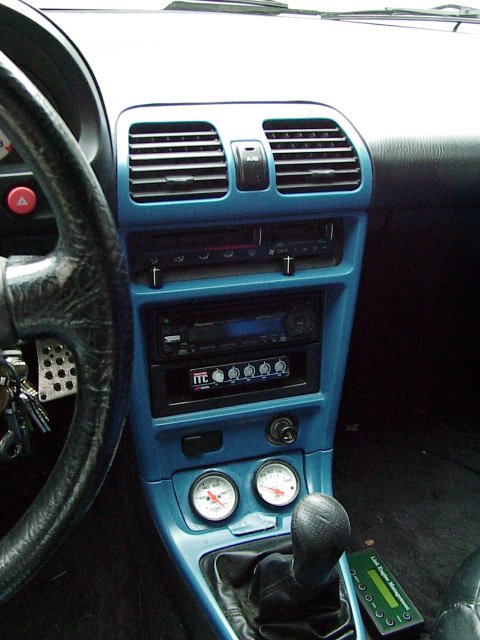
Most importantly, the occasional ping that was present above 4500 RPM is eliminated with 5º of retard in that range.
The unit fit right into the space below the radio. This gave me yet another thing to mess with when I'm driving and eliminated what was omly useful a place for throwing empty candy bar wrappers.